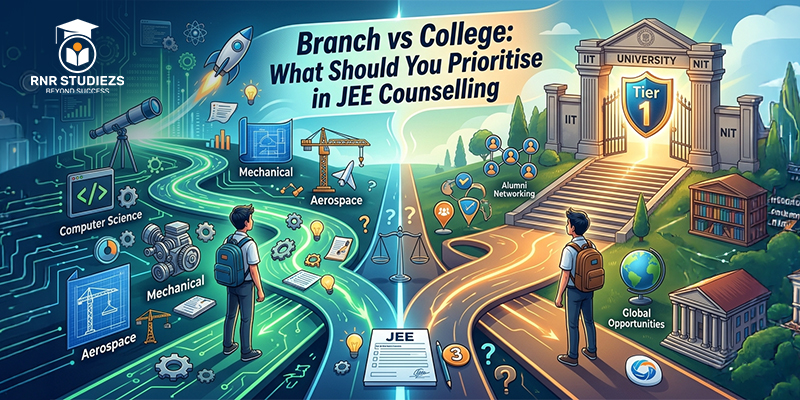
Branch vs College in JEE Counselling | Which Matters?
Here's something no one really tells you while you're busy preparing for JEE. Cracking the exam is one thing, but what comes right after can feel just as overwhelming. Counselling, seat allotments, the branch vs college debate. If you're still in school and wondering what any of this even means, you're in the right place. Getting clarity through JEE Main counselling now means you won't have to scramble for answers later.
Table of Contents
- Why Does Choosing a Branch or College After JEE Feel So Confusing?
- Which Matters More While Choosing: Branch or College Reputation?
- Is It Better To Take a Lower Branch in a Top College or a Preferred Branch in a Lesser-Known One?
- During JEE Main Counselling, How Much Does Branch Choice Impact Future Career Opportunities and Placements?
- Do Top Colleges Really Offer Better Exposure Even With a Less Preferred Branch?
- What Factors Should Be Compared Before Locking the Final Choice During Counselling?
Why Does Choosing a Branch or College After JEE Feel So Confusing?
Most students find this confusing because it is genuinely a two-sided decision. The branch decides what you study and eventually what field you work in. The college decides the environment, placements, and the name on your degree. Both carry real weight. And during JEE Main online counselling, having to weigh both at the same time with a rank in hand and a deadline approaching is what makes it feel overwhelming.
Which Matters More While Choosing: Branch or College Reputation?
Branch or college? Now this is an important question.
The answer actually depends on one thing most people overlook: how clear you are about what you want. If you already know your interest, go after the branch. Four years of studying something you genuinely like is a completely different experience from four years of pushing through something you don't. But if you are still exploring, the college environment does a lot of the heavy lifting. A better college often gives:
- Stronger peer group
- Better exposure to clubs, projects, and competitions
- More opportunities to explore different fields
Is It Better To Take a Lower Branch in a Top College or a Preferred Branch in a Lesser-Known One?
This is where most of the overthinking happens. There are two paths in front of you: a preferred branch in an average college, or a less preferred branch in a top college. Here is how to think about it:
- If the college is clearly better, like a top NIT versus an average private college, the college is worth it even with a less preferred branch.
- If the branch gap is big, like CS versus Civil, and both colleges are roughly at the same level, go with the branch.
- If both the college and branch gaps are small, always go with the one that interests you more.
And here is something worth remembering. Many students who don't study tech still end up working in tech. Projects, online courses, and internships can help fill the gaps. So, even though this choice is important, it isn't as final as it seems right now.
Next Read: Soft Skills in Engineering: Why They Matter and How Counselling Can Help
During JEE Main Counselling, How Much Does Branch Choice Impact Future Career Opportunities and Placements?
The branch does influence where you start. Some fields naturally have more direct placement opportunities than others. Tech branches often lead straight into software roles, while core branches like Mechanical or Civil may require deeper specialisation or further study to reach certain positions.
But things are not as straightforward as they seem. A student in a non-tech branch can still learn coding independently, build projects, and successfully apply for software roles. Many have done exactly that. And on the flip side, being in a top branch means nothing if the skills are not there.
So, during state counselling for JEE Mains, the branch gives you a direction. But it is the skills you build along the way that actually decide where you end up.
Do Top Colleges Really Offer Better Exposure Even With a Less Preferred Branch?
In most cases, yes. Exposure does not come only from what happens in a classroom. A lot of it comes from the people you are surrounded by, the events you attend, and the random opportunities you come across on campus. Top colleges tend to have buzzing clubs, frequent hackathons, seniors who have been where you want to go, and companies that actually show up for placements. All of this quietly pushes students to grow beyond just their branch.
Which is why many aspiring students going through Odisha JEE counselling still place college reputation high on their list, even when it means not getting the branch they originally wanted.
What Factors Should Be Compared Before Locking the Final Choice During Counselling?
Before locking in the final choice, do not just go with what feels right in the moment. Actually, sit down and compare. Here are a few things worth looking at:
- How much does the subject genuinely interest you
- What the college environment and culture look like
- Placement trends for that branch in that college
- How easy or hard is it to switch fields later
- Location and whether you will be comfortable there
- Internship and exposure opportunities available
Consider them, but do not stop there. Instead of just how you feel about each option today, think about where each one will realistically lead you in four years. Some choices seem exciting right now, but may not be what you really want. Others seem uncertain at first, but end up opening more doors than you thought.
Final Thoughts
At the end of the day, both paths can work. What matters is making a choice that actually fits you, not one made under pressure or confusion. If the branch vs college decision still feels confusing, RNR Studiezs offers JEE Main counselling to help you figure it out. Reach out and make your decision with confidence.
Frequently Asked Questions
- Can I get a software job with a non-CS branch?
Yes, many students from non-tech branches move into software roles by building skills through projects, coding courses, and internships outside of college. - Does the college name matter more than the branch for placements?
It depends on the gap between options, but in most cases, a significantly better college will offer stronger placement opportunities regardless of the branch. - Is it okay to change career fields after engineering?
Absolutely, many engineering graduates end up in fields completely different from their branch, and the skills and exposure gained in college play a bigger role than the branch itself.